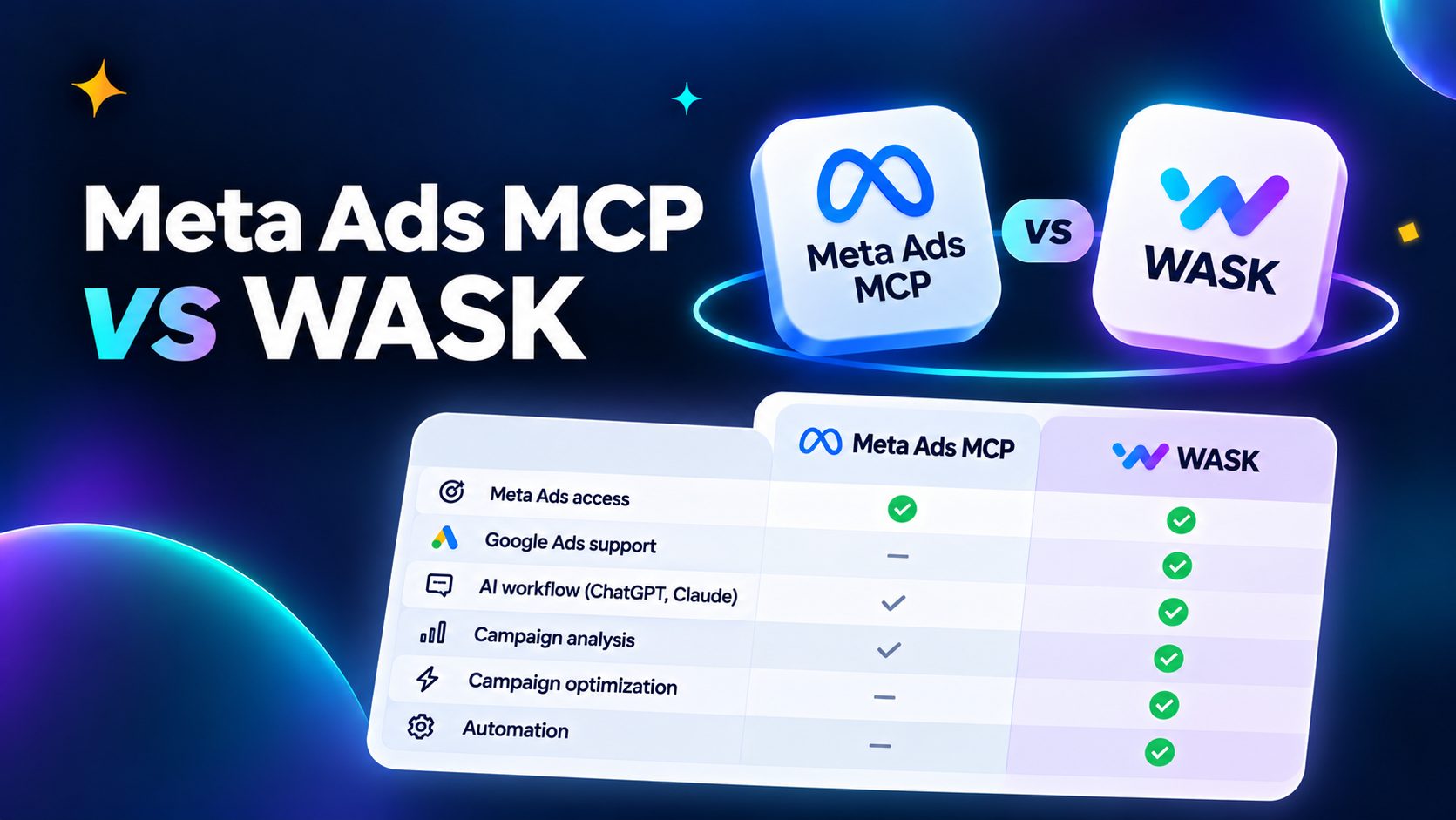
Choosing between Meta Ads MCP vs WASK comes down to what you expect your AI advertising workflow to do. Meta Ads MCP focuses on connecting AI assistants with Meta Ads tools and account data. WASK takes a broader approach by combining AI access with campaign analysis, optimization, creation, automation, and support for both Meta Ads and Google Ads.
If you mainly want a direct, Meta-focused connection for an AI assistant, an MCP implementation may be enough. If you want to manage advertising workflows across platforms from tools such as ChatGPT or Claude, WASK is likely the more complete option.
Quick Answer
For advertisers comparing Meta Ads MCP vs WASK, the biggest difference is scope.
Meta Ads MCP acts primarily as a connection layer between an AI assistant and Meta Ads. The exact tools available depend on the MCP server or implementation you use.
WASK provides an advertising platform with MCP support that lets users connect AI assistants to Google and Meta Ads while combining data access with campaign analysis, optimization, creation, automation, and marketing insights.
The better option therefore depends on whether you want direct Meta access or a broader advertising management workflow.
Meta Ads MCP vs WASK at a Glance
A useful way to understand the comparison is to separate access from advertising workflow. Meta Ads MCP gives an AI assistant a structured way to interact with Meta Ads. Depending on the implementation, that may include reading campaign data, accessing account information, creating campaigns or ad sets, and performing other supported actions.
WASK adds a management layer around advertising data. Through WASK MCP, advertisers can work with Google and Meta Ads through AI assistants while also using WASK’s optimization and analysis capabilities.
What Is Meta Ads MCP?
Meta Ads MCP refers to Model Context Protocol servers designed to connect AI assistants with Meta advertising accounts.
Instead of manually exporting campaign data and uploading files into an AI chat, an MCP connection can allow the assistant to access supported account information through tools.
This can make prompts such as these more practical:
- Which campaigns generated the highest ROAS this month?
- Which ad sets have the highest CPA?
- Compare campaign performance with last week.
- Show me campaigns with increasing spend but declining conversions.
When evaluating Meta Ads MCP vs WASK, remember that MCP itself is a protocol rather than a complete optimization strategy.
Different Meta Ads MCP servers can expose different tools, permissions, and actions. Current search results, for example, show implementations being compared by creation capabilities, spend guardrails, validation, permissions, and available account actions.
What Is WASK MCP?
WASK MCP connects advertising workflows with AI assistants such as ChatGPT and Claude.
Instead of focusing only on Meta Ads connectivity, WASK is designed around paid advertising management across Meta and Google Ads.
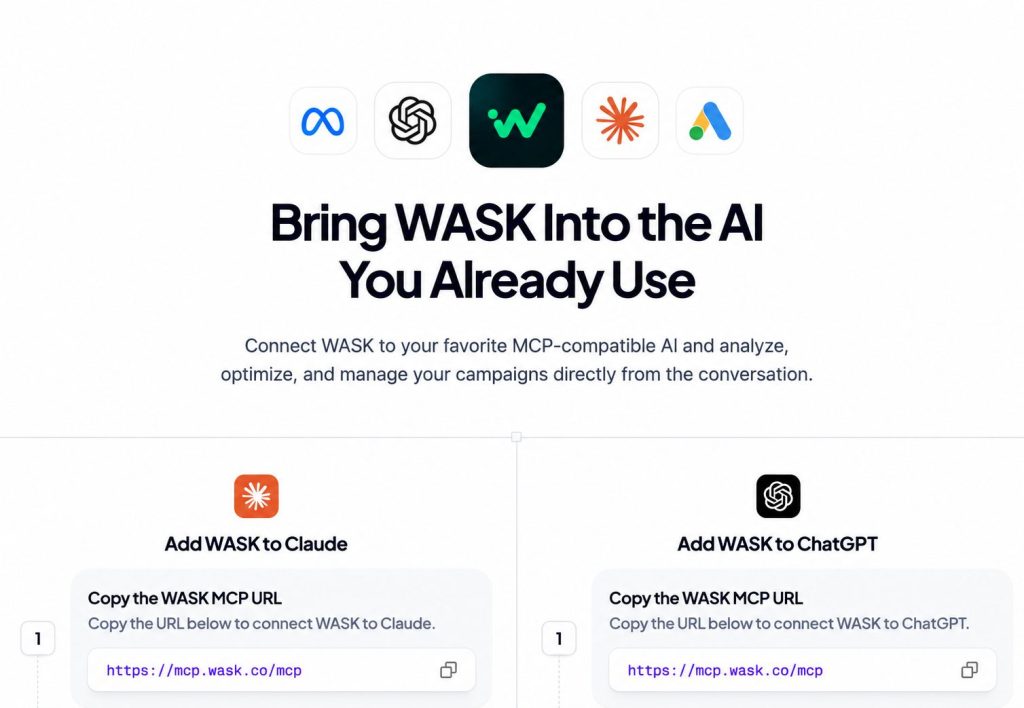
This means advertisers can use natural-language interactions to analyze performance, review campaigns, generate insights, create campaigns, and work with optimization and automation features.
In the Meta Ads MCP vs WASK comparison, this broader product layer is one of the most important differences.
WASK is not simply providing another route to retrieve Meta Ads data. The goal is to let advertisers use an AI assistant as an interface for managing advertising workflows.
Key Differences Between Meta Ads MCP and WASK
1. Platform Coverage
The first major difference in Meta Ads MCP vs WASK is platform coverage.
Meta Ads MCP is naturally centered on Meta advertising accounts.
WASK supports both Meta Ads and Google Ads. This matters for businesses that run paid acquisition across multiple platforms and do not want separate AI workflows for each advertising channel.
A multi-platform advertiser can therefore ask questions about both ecosystems through a broader advertising management setup.
2. ChatGPT and Claude Workflows
Both approaches can fit AI assistant workflows, but how they do it differs.
An MCP server exposes tools that an AI assistant can call. The functionality you receive depends on the implementation and permissions available.
WASK is designed specifically around advertising use cases for assistants such as ChatGPT and Claude.
When considering Meta Ads MCP vs WASK, users who want a ready advertising workflow may prefer the additional product layer, while technical users may prefer more direct control over an MCP setup.
3. Performance Analysis
Accessing campaign data is only the first part of useful AI advertising.
Advertisers usually want answers such as:
- Why did CPA increase?
- Which campaign is wasting budget?
- Which ad deserves more spend?
- Where did ROAS decline?
- Which campaigns should be reviewed first?
Meta Ads MCP can provide the data and tools an AI assistant needs to investigate these questions.
WASK combines that AI access with advertising-focused analysis and optimization capabilities.
This makes performance analysis a major distinction in Meta Ads MCP vs WASK.
4. Campaign Creation and Management
AI advertising workflows are increasingly moving beyond reporting.
Advertisers may want to create or manage campaigns directly from a conversational interface.
Some Meta Ads MCP implementations support campaign or ad set creation, but their exact capabilities vary.
WASK positions campaign creation as part of its MCP advertising workflow, allowing users to move from analysis toward execution without treating every task as a separate integration.
5. Campaign Optimization
MCP connectivity does not automatically equal optimization.
A connection can give an AI model access to advertising information, but the quality of the recommendation still depends on available data, tools, instructions, and context.
For advertisers comparing Meta Ads MCP vs WASK, WASK’s advantage is that optimization is part of the broader product rather than something that must be designed entirely around the connector.
This is especially relevant for users who want to identify inefficient campaigns, review budget allocation, or find opportunities without building their own advertising logic.
6. Automation
Automation is another important consideration.
An MCP implementation may expose actions that an AI agent can call. What can be automated depends on the server, its permission model, and available tools.
WASK approaches automation as part of an advertising platform.
In the Meta Ads MCP vs WASK decision, this makes WASK more suitable for advertisers who want AI interaction plus an existing optimization and automation environment.
Meta Ads MCP vs WASK Comparison Table
The table highlights why Meta Ads MCP vs WASK is not simply a comparison between two identical connectors.
| Feature | Meta Ads MCP | WASK |
|---|---|---|
| Platform coverage | Meta Ads only | Meta Ads and Google Ads |
| Setup | Add the MCP server URL as a custom connector and sign in with Facebook | WASK listing in Claude or ChatGPT, or the WASK MCP URL |
| Performance analysis | AI assistant analyzes data returned by Meta’s tools | AI-assisted analysis across Meta and Google campaigns |
| Campaign creation | Supported for Meta campaigns | Supported for Meta and Google campaigns |
| Optimization and automation | Depends on your own prompts and workflow logic | Built-in AI Workflow optimization and automation |
| Creative improvement | Not included | AI Ad Creative for underperforming creatives |
| Best for | Meta-only advertisers and technical teams | Multi-platform advertisers and agencies |
They solve overlapping problems from different product layers.
When Should You Use Meta Ads MCP?
Choose a direct Meta Ads MCP approach when your workflow is primarily Meta-focused and you want more control over the technical connection.
It can make sense when you:
- Only need Meta Ads
- Already have your own optimization logic
- Want to build custom AI workflows
- Have technical resources
- Need specific account actions
- Want to control tools and permissions directly
For these users, Meta Ads MCP vs WASK may lean toward MCP because the additional management layer is not always necessary.
When Should You Use WASK?
WASK makes more sense when you want the AI connection to be part of a wider advertising workflow.
It is particularly relevant when you:
- Manage both Meta and Google Ads
- Want performance analysis through AI
- Need campaign optimization
- Want to create or manage campaigns
- Prefer a ready advertising platform
- Want automation without building the entire workflow yourself
In this Meta Ads MCP vs WASK scenario, WASK reduces the amount of advertising infrastructure the user needs to assemble independently.
Can You Use Both?
These approaches do not have to be treated as mutually exclusive.
Technical teams may use different MCP connections for specialized workflows while using an advertising platform for broader campaign monitoring and optimization.
The important question is not how many tools you can connect. It is whether each tool has a clear role in your workflow.
Adding another connector without a defined use case can increase complexity rather than reduce it.
Which Is Better for Agencies?
Agencies often manage multiple advertisers, platforms, campaigns, budgets, and reporting requirements.
A direct MCP implementation can be useful for teams building custom internal systems.
However, an agency that wants an easier way to analyze and manage both Google and Meta campaigns may benefit more from a dedicated advertising platform.
The Meta Ads MCP vs WASK choice therefore depends heavily on whether the agency wants to build its own AI advertising infrastructure or use an existing optimization environment.
Which Is Better for Multi-Platform Advertisers?
For advertisers using only Meta Ads, a Meta-specific MCP connection can cover many useful AI tasks.
The situation changes when Google Ads enters the workflow. Running separate systems for each platform can make reporting, analysis, and campaign management more fragmented. WASK‘s Google and Meta Ads support gives it a clearer advantage for advertisers trying to centralize paid acquisition workflows.
Use Meta Ads MCP when you want direct, Meta-focused AI access and are comfortable defining your own tools, prompts, controls, and workflow.
Use WASK when you want a broader advertising management layer that combines Meta and Google Ads with AI-assisted analysis, campaign creation, optimization, automation, and marketing insights.
For most advertisers, the decision should be based less on the MCP technology itself and more on how much of the advertising workflow they want the platform to handle.
Frequently Asked Questions
Does Meta Ads MCP replace Meta Ads Manager?
No. MCP provides a way for AI assistants to access supported tools and data. The exact functionality depends on the implementation.
Can WASK connect Meta Ads to ChatGPT?
Yes. WASK MCP is designed to bring advertising workflows into supported AI assistants such as ChatGPT and Claude.
Does WASK work only with Meta Ads?
No. WASK supports both Google Ads and Meta Ads, which is one of the major differences when comparing the two approaches.
Is Meta Ads MCP better for developers?
It can be. Developers who want direct control over tools, permissions, and custom workflows may prefer an MCP implementation they can configure around their own requirements.
Is WASK better for advertisers?
For advertisers who want analysis, optimization, automation, and multi-platform management without constructing the entire system themselves, WASK can offer the more complete workflow.
Related Articles