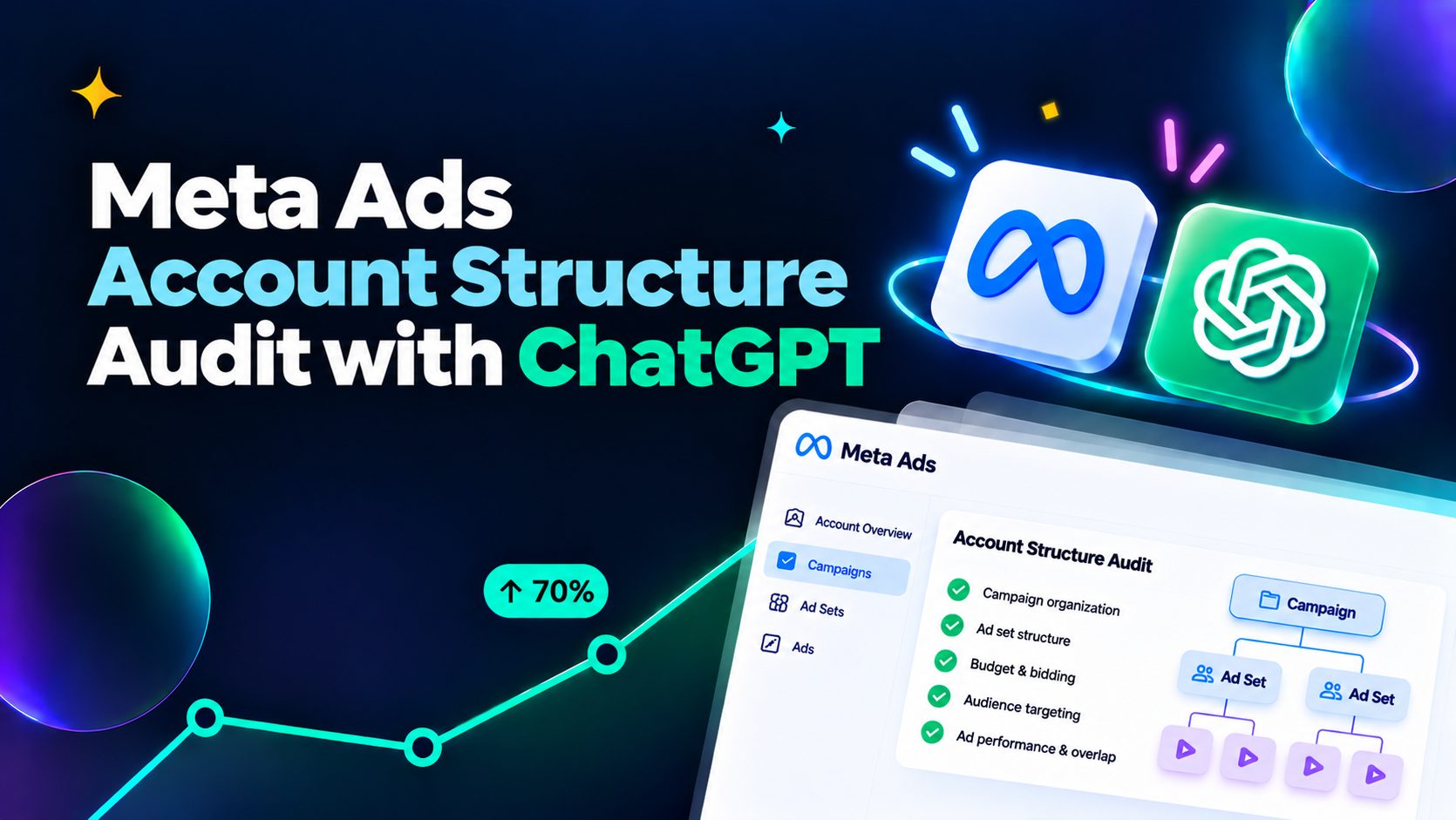
A Meta Ads Account Structure Audit with ChatGPT helps you evaluate whether your campaigns, ad sets, audiences, budgets, and objectives are organized in a way that supports efficient delivery. Instead of reviewing every campaign manually, you can use AI to identify structural problems such as duplicated campaigns, budget fragmentation, objective mismatches, overlapping audiences, and weak segmentation.
The goal is not to let ChatGPT make account changes automatically. A strong audit uses AI to organize evidence, highlight risks, and suggest areas that deserve human review.
Quick Answer
A Meta Ads Account Structure Audit with ChatGPT starts with clean account data and clear business context. Export your campaign, ad set, ad, audience, budget, objective, spend, conversion, CPA, ROAS, and delivery data. Then ask ChatGPT to review the account in layers: campaign objectives, segmentation, ad set structure, targeting overlap, budget allocation, tracking quality, and creative distribution.
The most useful output is a prioritized list of structural issues, each supported by account data and followed by a recommended action.
What Is a Meta Ads Account Structure Audit?
A Meta Ads structure audit checks whether the account hierarchy supports your advertising goals.
Meta Ads accounts are organized across three main layers: campaign, ad set, and ad. Campaigns define the objective and budget strategy, ad sets control audiences and delivery settings, and ads contain creative and messaging.
A Meta Ads Account Structure Audit with ChatGPT evaluates whether these layers work together logically or create unnecessary complexity.
Why Use ChatGPT for a Meta Ads Structure Audit?
Large Meta accounts can become difficult to review manually. Multiple campaigns may target similar audiences, budgets may be spread too thin, and old structures may remain active after strategy changes.
A Meta Ads Account Structure Audit with ChatGPT can summarize datasets and flag inconsistent objectives, duplicated structures, targeting overlap, budget fragmentation, strong campaigns with limited budget, and weak ad sets consuming disproportionate spend. These findings should still be validated against business goals and campaign history.
What Data Should You Collect Before the Audit?
Before starting a Meta Ads Account Structure Audit with ChatGPT, gather enough data to provide context.
Useful fields include campaign and ad set names, objectives, audiences, targeting, budgets, spend, reach, frequency, clicks, CTR, CPC, conversions, cost per result, conversion value, and ROAS.
Also explain your conversion goal, target CPA or ROAS, products, markets, prospecting vs retargeting strategy, and important seasonal factors. Without this context, ChatGPT may identify patterns correctly but interpret them incorrectly.
Meta Ads Account Structure Audit with ChatGPT Step by Step
A useful Meta Ads Account Structure Audit with ChatGPT should move from the highest account level to the most detailed one.
| Audit Step | What to Review |
|---|---|
| 1. Review Campaign Objectives | Start by checking whether every campaign objective matches the business outcome you actually want. Ask ChatGPT to flag campaigns where the selected objective appears inconsistent with the intended business outcome or conversion action, especially in accounts that still contain legacy campaigns. |
| 2. Check Campaign Segmentation | Review whether campaigns are separated logically. Campaigns may be segmented by market, product line, funnel stage, audience type, or objective. Excessive segmentation can create low-volume campaigns with too little data. ChatGPT can compare names, objectives, audiences, and performance to find unnecessary duplication. |
| 3. Audit Ad Set Structure | Review the purpose of each ad set. Ask whether multiple ad sets compete for similar users, have enough volume to learn effectively, and differ enough in targeting to justify separate structures. |
| 4. Find Audience Overlap | Audience overlap can create internal competition and make performance harder to interpret. Provide audience names, targeting criteria, custom audiences, retargeting groups, and exclusions. Ask ChatGPT to identify likely overlap. Some overlap may be intentional; the question is whether it creates unnecessary duplication or budget competition. |
| 5. Review Budget Distribution | Analyze how budget is distributed across campaigns and ad sets. Look for strong campaigns constrained by budget, weak campaigns receiving too much spend, and low-budget campaigns that may be candidates for consolidation. Compare allocation with CPA, ROAS, conversion volume, and strategic importance. |
| 6. Check for Budget Fragmentation | Budget fragmentation happens when spend is divided across too many campaigns or ad sets. A Meta Ads Account Structure Audit with ChatGPT can help identify structures where each segment receives too little budget to generate meaningful data. Ask ChatGPT to find cases where budget distribution appears too fragmented relative to spend, conversions, and campaign purpose. |
| 7. Analyze Ad Set Performance | Structure and performance should be reviewed together. Compare ad sets using cost per result, conversion rate, frequency, reach, spend, and ROAS. Do not remove a low-performing ad set without considering its audience role, funnel stage, and sample size. |
| 8. Review Ads and Creative Distribution | An account can have a clean campaign structure but weak creative distribution. Check whether ad sets contain enough creative variation, whether the same ads are repeated excessively, and whether high-performing creatives receive enough delivery. |
| 9. Check Conversion Tracking | A structure audit is unreliable if the conversion data itself is unreliable. Review Pixel implementation, Conversions API, event selection, attribution settings, and the primary optimization event. Weak tracking should be flagged before trusting CPA or ROAS conclusions. |
| 10. Prioritize Structural Fixes | Do not finish with a long list of disconnected observations. Ask ChatGPT to group issues by impact:
|
A Meta Ads Account Structure Audit with ChatGPT is most useful when it turns account complexity into a clear sequence of actions.
Best ChatGPT Prompt for a Meta Ads Structure Audit
Use a prompt like this:
“Act as a Meta Ads account auditor. Review the campaign, ad set, audience, budget, objective, conversion, and performance data I provide. Identify objective mismatches, duplicated structures, audience overlap, budget fragmentation, tracking risks, and inefficient segmentation. For every issue, explain the evidence, likely impact, recommended action, and confidence level. Do not recommend changes when the data is insufficient.”
This reduces vague recommendations.
What ChatGPT Can and Cannot Audit Reliably
A Meta Ads Account Structure Audit with ChatGPT is strong at pattern recognition, comparison, classification, and summarization. For a broader AI-assisted advertising workflow, you can also learn how to manage Google Ads campaigns from ChatGPT and apply a similar structured approach to campaign analysis and optimization.
It can identify repeated structures, inconsistent naming, unusual budget allocation, overlapping targeting logic, and clear performance differences. But it does not know why a campaign exists unless you provide context such as offline sales, internal priorities, inventory constraints, or seasonal strategy.
Common Meta Ads Structure Mistakes
Common problems include too many campaigns, unnecessary audience separation, duplicated ad sets, thin budgets, mixed prospecting and retargeting logic, and outdated campaigns.
Avoid optimizing structure only around short-term results; a low-volume campaign may still serve a strategic role. The best structure gives Meta enough data while keeping goals, audiences, budgets, and reporting clear.
How WASK Can Help Optimize Meta Ads
A Meta Ads Account Structure Audit with ChatGPT is useful for diagnosis, but ongoing optimization requires continuous monitoring.
WASK helps advertisers analyze Meta campaign performance and identify optimization opportunities from a centralized platform, connecting structural findings with budget and campaign-level decisions.
Turn the Audit Into a Better Account Structure
The real value of a Meta Ads Account Structure Audit with ChatGPT is turning a complicated account into a clear decision framework.
Use ChatGPT to organize data, compare structures, and identify likely problems. Then validate each recommendation against business goals, historical performance, and tracking quality before making changes.
Frequently Asked Questions
Can ChatGPT audit a Meta Ads account?
Yes. ChatGPT can analyze exported Meta Ads data, compare campaign and ad set structures, flag potential issues, and help prioritize changes.
What should I include in a Meta Ads structure audit?
Review campaign objectives, segmentation, ad sets, audiences, targeting overlap, budgets, tracking, creative distribution, and performance.
Can ChatGPT detect audience overlap?
It can identify likely overlap when you provide audience definitions and targeting criteria. However, account-level platform data and human validation are still important.
Should ChatGPT automatically change my campaigns?
No. Structural recommendations should be reviewed before applying changes to live campaigns.
Related Articles